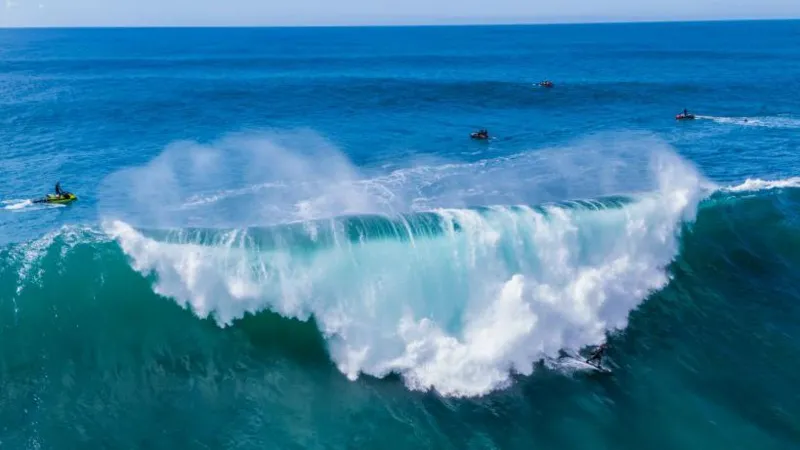
Photo courtesy: Jonah Fisher, BBC Environment Correspondent, Weymouth.
Abstract: What if India's pathway to net zero does not end at factories—but begins where terrestrial meets the coastal? As carbon emissions rise and climate risks intensify, the search for solutions has largely remained confined to land-based approaches. Yet beneath the waves lies an overlooked trillion-dollar economic and ecological frontier, one that can absorb carbon, shield coastlines, and sustain growth. The question is no longer whether the blue economy matters, but why it remains on the margins of India’s climate strategy.
(Corresponding author) Sovini Mondal, Research Associate at National Council of Applied Economic Research (NCAER), New Delhi, India (email: smondal@ncaer.org)
Sanjib Pohit, Professor at National Council of Applied Economic Research (NCAER), New Delhi, India (email: spohit@ncaer.org)
What if India's pathway to net zero does not end at factories—but begins where terrestrial meets the coastal? As carbon emissions rise and climate risks intensify, the search for solutions has largely...
India is set to embark on a new chapter in its Polar exploration journey with the construction of Maitri II. The Indian government plans to establish a new research station near the existing Maitri ba...
The Deep Ocean Mission (DOM), approved by the Government of India in 2021 under the Ministry of Earth Sciences (MoES), represents a strategic step in realizing Sustainable Development Goal 14 (SDG 14:...
China recently announced restrictions on the export of seven rare earth elements (REEs), soon after US President Donald Trump decided to impose tariffs. As the world's dominant supplier—responsible fo...